
What size power station do I need for power tools?
On a site without grid power, output matters more than capacity. A circular saw draws around 1,400 W and much more as it starts. Tools are used one at a time, so we count the biggest one plus everything that is always on.
A typical setup
These devices at these power levels, for 24 hours without recharging. Adjust them to yours with the button below.
| Device | W | Surge W | h/day | Wh/day |
|---|---|---|---|---|
| Power tool battery charger | 150 W | 150 W | 1.5 | 225 Wh |
| Drill | 600 W | 1,200 W | 0.5 | 300 Wh |
| Circular saw | 1,400 W | 2,300 W | 0.5 | 700 Wh |
| Work light | 50 W | 50 W | 4 | 200 Wh |
| Phone | 15 W | 15 W | 2 | 30 Wh |
- 1,455 Wh
- 2,055 Wh
- 1,615 W
- 2,515 W
Estimates based on typical consumption. They include inverter losses and a 20% reserve.
Recommended for this typical use
No battery in stock meets every requirement according to its spec sheet. Try fewer days, no weight limit or a bigger budget.
Might work, but a figure is missing
They meet everything their spec sheet lists, but the manufacturer does not publish one of the figures we need. We do not count them as a match.
Power stations
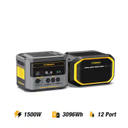
3,096 Wh nominal for the 2,060 Wh you need (usable capacity not published)
Missing: continuous output and surge power.
Power stations
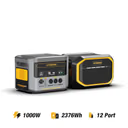
2,376 Wh nominal for the 2,060 Wh you need (usable capacity not published)
Missing: continuous output and surge power.
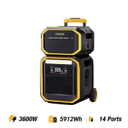
- VTOMAN FlashSpeed Pro 3600 V-BEYOND® Portable Power Station – VTOMAN FlashSpeed Pro 3600 + Extra Battery£304/kWh£1,799.00
Power stations
5,912 Wh nominal for the 2,060 Wh you need (usable capacity not published)
Missing: continuous output and surge power.
Sorted by price per usable kWh among those that meet everything. Retailer commissions play no part. How we rank
How we calculate it
For each device we multiply its power by the hours per day and by the share of time it actually runs (a fridge only runs its compressor part of the time). We add them up and multiply by the days without recharging.
We divide that total by the inverter efficiency, which we take as 85%, and add a 20% reserve for cold weather, cell wear and not draining the battery completely. We compare it with the usable capacity the manufacturer declares, or the nominal one if it does not publish it, and we flag that.
Continuous output is the sum of what runs at the same time. Kitchen appliances and tools count one at a time, the biggest one. Surge power adds what the device with the highest start-up demand draws when it switches on.
We do not recommend batteries with more than three times the capacity you need, because you would pay for and carry capacity you will not use. If a battery is missing a figure we need, such as surge or solar input, we do not count it as a match.
Typical power figures for 230 V household power.